
Écrit par : Carl Wright, vice-président, Stratégie de commercialisation pour le secteur public, Hyperscience
Nul n'ignore que les agences chargées de gérer les prestations du Programme d'aide alimentaire supplémentaire (SNAP) sont confrontées à l'un des changements opérationnels les plus importants de ces dernières décennies.
Le fédéral Mandat HR 1 Les réformes connexes ont profondément modifié les exigences en matière de vérification et de renouvellement d'admissibilité. Les États doivent désormais traiter des volumes de documents considérablement plus importants, effectuer des contrôles d'admissibilité plus fréquents et maintenir leur taux d'erreur de paiement (TEP) en dessous de 61 000 000, sous peine de sanctions financières substantielles liées au financement fédéral.
Parallèlement, alors que plus de 40 millions d'Américains dépendent des prestations du programme SNAP, les cycles de renouvellement se sont intensifiés et les retards dans le traitement des demandes ne cessent de s'accumuler. De nombreux États s'appuient encore sur des procédures manuelles et lourdes, et par conséquent, on estime que 401 millions de demandes sont rejetées chaque année en raison de documents incomplets ou incorrects.
Si certains se sont tournés vers l'IA généraliste ou les grands modèles de langage (LLM) comme solution rapide, ces outils ne sont pas conçus pour gérer la forte variabilité, l'écriture manuscrite, les incohérences de mise en forme et la précision des données structurées requises pour plus de 30 types de documents d'admissibilité au programme SNAP. Développer de la technologie pour le simple plaisir de la technologie relève de la science. Les États ont besoin d'un impact opérationnel.
Entrez dans Hypercell pour SNAP
C’est pourquoi, à l’automne 2025, nous avons lancé Hypercell pour SNAP, une solution modulaire et évolutive qui aide les administrations étatiques et locales à gérer les défis opérationnels du programme SNAP, notamment la complexité du traitement de plus de 30 types de documents d’admissibilité par demandeur, avec des formats variés et des problèmes d’écriture manuscrite fréquents, pour des millions de personnes. Parmi ces documents figurent les permis de conduire, les cartes d’identité, les passeports, les contrats de location, les factures de services publics, les relevés hypothécaires, les bulletins de salaire, les attestations d’employeur, les déclarations de revenus, les reçus de garde d’enfants, les relevés bancaires, les cartes grises et bien d’autres. Alors que d’autres technologies échouent face à cette grande diversité de documents, Hypercell pour SNAP excelle dans les environnements où le volume de documents complexes et variés est important.
En déployant une solution éprouvée axée sur l'IA dans ce flux de travail essentiel et fortement documenté, et en assurant des flux de données précis vers les systèmes en aval, les États peuvent réduire les erreurs de paiement de 50%, réduire les coûts administratifs et fournir les prestations SNAP beaucoup plus rapidement, réduisant le délai de paiement moyen de 26 jours à environ sept jours et améliorant les résultats en matière de santé.
Solution de l'année 2026 selon Deep Analysis
Mais ne nous croyez pas sur parole. Analyse approfondie, un cabinet d'analystes de premier plan spécialisé dans la recherche et les services de conseil en gestion de l'information et des processus, et plus particulièrement axé sur le marché de l'automatisation des données non structurées, nommé Hypercell pour SNAP Nous avons reçu le prix de la Solution de l'année 2026, qui récompense notre innovation et notre impact mesurable dans la transformation du traitement des prestations SNAP pour les gouvernements des États américains.
Chaque année, Deep Analysis évalue des centaines de fournisseurs, allant au-delà des simples listes de fonctionnalités et du discours marketing pour identifier les solutions qui apportent une réelle valeur ajoutée aux entreprises. Dans un marché saturé de promesses en matière d'IA et d'expérimentations d'IA générale, les entreprises qui se distinguent sont celles qui résolvent des problèmes urgents et à forts enjeux, avec des résultats concrets. Deep Analysis a distingué Hypercell pour SNAP comme une solution structurée offrant des résultats tangibles : elle aide les États à se conformer aux exigences fédérales, à réduire les risques et à verser les prestations plus rapidement et avec plus de précision aux personnes qui en ont le plus besoin.
Deep Analysis a annoncé ce prix dans son rapport annuel sur le marché IDP : Analyse du marché du traitement intelligent des documents 2026-2030 : L’essor des agents.
Nous sommes honorés que Deep Analysis ait désigné Hypercell pour SNAP comme la Solution de l'année et encore plus fiers de l'impact que cette solution a sur les agences et les communautés qu'elles servent.
Transition du traitement SNAP à l'ère de l'IA
Hypercell pour SNAP marque une rupture avec les outils fragmentés et la vérification manuelle, au profit d'une plateforme unique et évolutive, conçue spécifiquement pour répondre aux exigences de la complexité des documents du secteur public. Elle transforme les obligations de recertification, d'une contrainte administrative, en une opportunité de modernisation opérationnelle.
Face au durcissement des exigences fédérales et à l'augmentation du nombre de dossiers à traiter, les États ont besoin de bien plus qu'une amélioration progressive. Ils ont besoin d'une base solide pour se conformer à la réglementation.
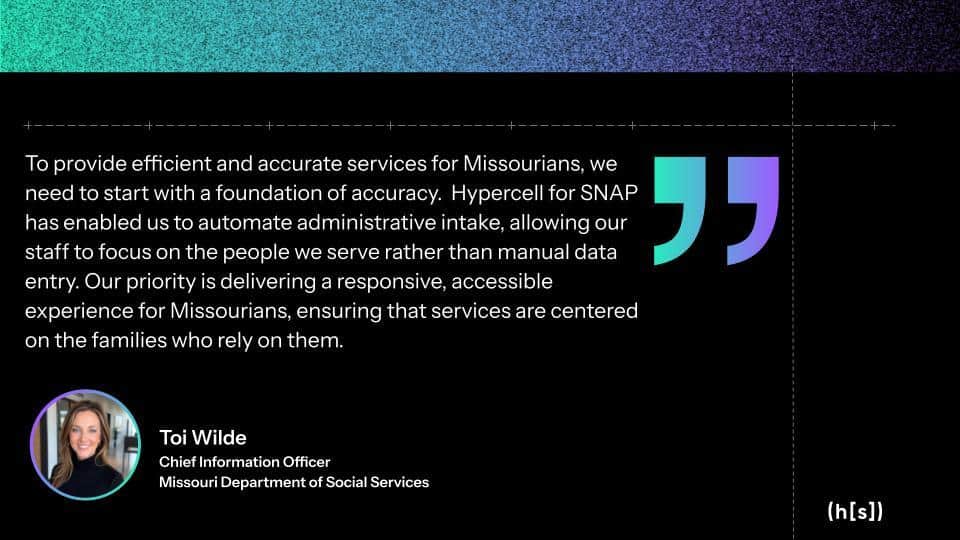
Pour relever ces défis croissants, le département des services sociaux du Missouri (DSS), sous la direction de sa directrice des systèmes d'information, Toi Wilde, a mis en œuvre de manière proactive Hypercell pour le programme SNAP. Cette solution évolutive permet à la division du soutien aux familles de gérer la complexité du traitement de plus de 30 types de documents d'admissibilité différents pour des centaines de milliers de demandeurs.
La mise en œuvre de cette technologie a eu des retombées considérables pour les habitants du Missouri, notamment :
- Précision améliorée : En automatisant l'extraction initiale des données, le Missouri réduit les erreurs de traitement des documents qui peuvent entraîner des retards dans le versement des prestations.
- Temps de réponse plus rapides : La réduction de la saisie manuelle des données permet à l'État d'identifier plus rapidement les informations manquantes, permettant ainsi au personnel d'aider les demandeurs à corriger leurs erreurs avant qu'elles n'entraînent un refus.
- Personnel responsabilisé : En prenant en charge les tâches fastidieuses de saisie des données, cette technologie permet aux travailleurs sociaux de se concentrer sur une gestion de cas personnalisée et d'apporter une aide directe à ceux qui en ont le plus besoin.
- Gestion financière responsable : Le Missouri prévoit de réduire considérablement son PER d'ici fin 2026, en s'assurant de manière proactive le financement fédéral de l'État et en veillant à ce que chaque dollar soit utilisé efficacement.
Conformément aux normes du Missouri en matière d'IA, le DSS privilégie une approche centrée sur l'humain. Si l'automatisation prend en charge l'extraction des données des formulaires papier, les décisions finales d'admissibilité sont toujours prises par le personnel qualifié du DSS. Ainsi, la technologie facilite l'accès aux services – rendant le système plus rapide et plus précis – sans pour autant négliger l'élément humain essentiel à un service juste et équitable.
Pour en savoir plus sur la modernisation du traitement des prestations sociales dans le Missouri, cliquez ici. ici. Pour en savoir plus sur Hypercell pour SNAP et comment il aide les États à réduire le PER, à éviter les pénalités et à moderniser le traitement de l'admissibilité, consultez notre site web. Page Hypercell pour les solutions SNAP.
Hyperscience est une APHSA Partenaire stratégique de l’industrie.
À propos de l'auteur

Carl Wright
Vice-président, Stratégie de commercialisation pour le secteur public, Hyperscience
Carl Wright est un dirigeant chevronné du secteur public spécialisé dans les technologies, reconnu pour sa capacité à créer et à développer des organisations commerciales à forte croissance dans les secteurs public, de la défense et des industries réglementées. En tant que vice-président de la stratégie de commercialisation pour le secteur public chez Hyperscience, il pilote la stratégie et la mise en œuvre de solutions d'automatisation basées sur l'IA pour les agences gouvernementales, contribuant ainsi à améliorer la précision, l'efficacité et la sécurité de leurs opérations critiques.
Carl possède une solide expertise dans le lancement et le développement de technologies émergentes au sein du secteur public fédéral. Avant de rejoindre Hyperscience, il a occupé plusieurs postes de direction chez WalkMe, où il a joué un rôle déterminant dans la création et le développement des activités de l'entreprise auprès du secteur public.
Au début de sa carrière, Carl a occupé des postes de direction chez Qualtrics, ThoughtSpot, Pluralsight et Cornerstone OnDemand, où il s'est concentré sur la stratégie de commercialisation fédérale, la transformation des talents et l'adoption des technologies.
Carl est titulaire d'une licence en administration des affaires de The Citadel, avec une spécialisation en systèmes d'information de gestion, et a obtenu son MBA en contrats de défense fédérale de l'université George Mason.