
Written By: Shari Blades, LCSW-C, Director, Caroline County Department of Social Services
The Coordinating SNAP and Nutrition Supports (CSNS) program strengthens access to human services by aligning the Supplemental Nutrition Assistance Program (SNAP) with other nutrition supports. CSNS also works to center individuals with lived experience by giving them a voice through the Community Impact Council (CIC), which guides the funding of innovative projects. The blog post below is part of a series from APHSA that will share insights and stories from each team involved, highlighting the program’s impact on service delivery and community engagement.
Tucked away across the Chesapeake Bay Bridge, you’ll find the tight-knit, rural community of Caroline County in Maryland’s Eastern Shore. As the Director of Caroline County’s Local Department of Social Services (LDSS), I was thrilled to learn we would be part of APHSA’s Coordinating SNAP and Nutrition Supports (CSNS) 2.0 Cohort, a program designed to align federal, state, and local nutrition supports to assist children and families in gaining food security.
For our team and partner organizations, participating in CSNS has helped us rethink our approach to human services, especially when it comes to public benefits like the Supplemental Nutrition Assistance Program (SNAP). The cohort encouraged us to slow down, examine how our services are delivered, and ask, “How can we make this more human-centered?”
Initiating the Community Navigation Project
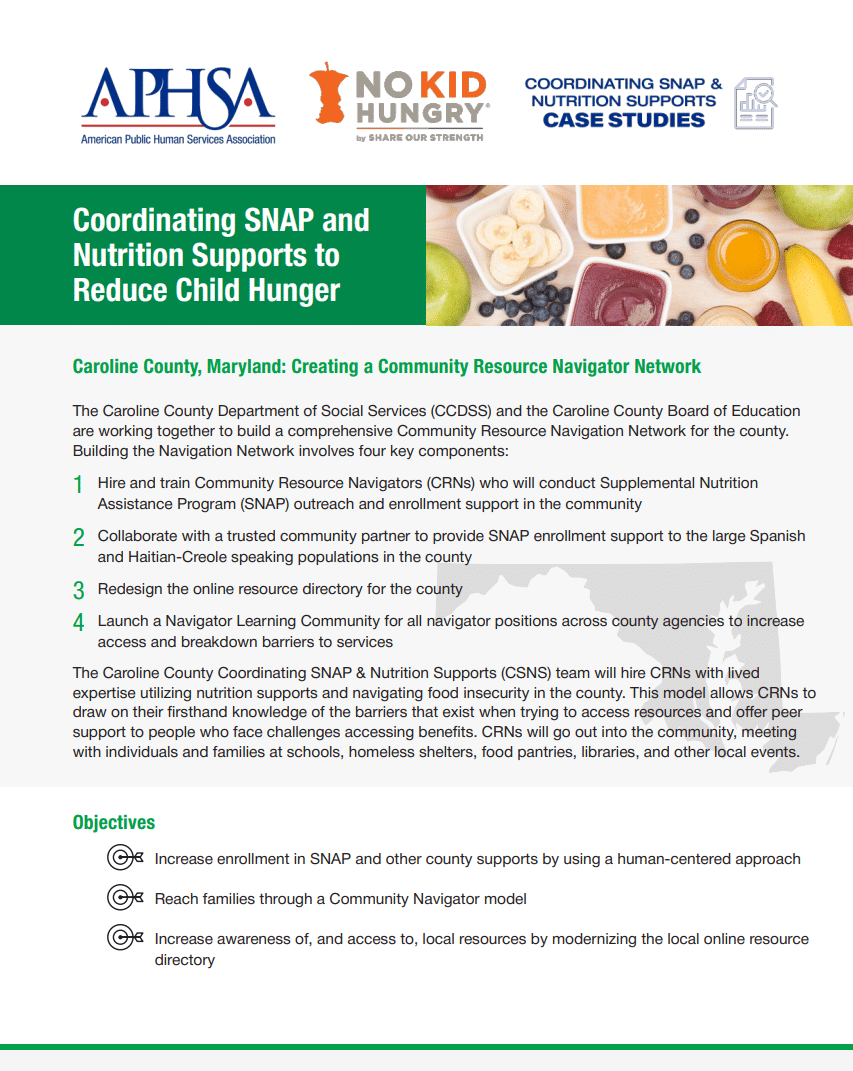
During our cohort, we outlined plans to reach Marylanders who are eligible for SNAP but are not yet enrolled. To do this, we launched a Community Navigation Project and hired the first of several Community Resource Navigators to lead this initiative by travelling throughout the community to reach families where they are. The Community Resource Navigators connect customers to resources and help them discover which benefits they’re eligible for. Being this hands-on with customers encourages us to intentionally center their perspectives.
Since joining the cohort, we have also worked with the Caroline County Public School District and the Chesapeake Multicultural Resource Center (ChesMRC) to embed people with real-life experience navigating public benefit systems into the role of Resource Navigator.
The Effect of Meeting Customers Where They Are
Community Resource Navigators are more than just connectors—they’re bridges, removing major barriers in tangible ways:
- ChesMRC has deployed multilingual team members who are fluent in Haitian-Creole and Spanish—two of the most common languages spoken among Caroline County’s immigrant communities—to work directly with these residents. In our rural region, it would be easy to forgo going the extra mile, but we strongly believe that this action is making an impact.
- Our Resource Navigators focus on our community members who can’t easily reach an LDSS office or struggle with technology. They meet people where they are—at community centers, libraries, churches—wherever they feel most comfortable.
Renee, one of our Resource Navigators, relayed that many people are moved when they hear from us. Our follow-up call lets them know that we are on the case, even if the issue isn’t resolved right away. Having been in their position, Renee shared, “I know what it feels like not knowing if your paperwork made it through.” She is always intentional about reaching out and making sure customers know someone is in their corner. That simple gesture may seem small, but it makes a big difference in the lives of our community members.
Our involvement in CSNS has meant that we’re not just delivering services, we’re building trust, breaking down barriers, and making public benefits truly accessible for everyone in our community.
About the Author
Shari Blades, LCSW-C
Director, Caroline County Department of Social Services, Maryland Department of Human Services
Special thanks to Matthew Peters, Executive Director of the Chesapeake Multicultural Resource Center and Beth Brewster, Supervisor of Nutrition Services at Caroline County Public Schools for their role as key thought partners throughout the project.
Share this post on your social media accounts: